
Do you have a favorite shirt and don’t want to throw into the garbage ‘coz you wore it when you hand your first kiss? Or you wore it when you caught your boyfriend cheating on you and it will serve as a reminder that you will not fall in love again with same kind of good-looking and egocentric guy.
The good news! Here are the 7 ways to give it a second chance (not the guy but the T-shirt).
1. A tee that’s too small or faded to wear on its own makes a great layering piece. Thinner tees or camisoles can look so stylish when you pile one on top of another. Choose two shirts in coordinating colors and let the first layer peek out at the bottom.
 2. Cut off the sleeves and make it a cute tank top. Give it a slightly military look sewing patches on the front and bunching the shoulders together and securing them with a gold or silver chain from the crafts store.
3. Change the color! Channel your inner hippie and break out the tie-dye. Or just dye it a few shades darker. This works even with old concert tees, or anything with writing on it.
 4. Sew buttons of various sizes along the neckline for a necklace effect. Pick out buttons in coordinating colors or fun shapes, or for a slightly dressier look, try metal buttons with a silver or gold finish.

5. Take a T-shirt that’s slightly baggy at the waistline and cut four 2-inch vertical slits in the front and in the back, lace it with a ribbon and tie it as a belt.
6. Cut some small slits or holes into a shirt that can be layered over another tee or a tank top, letting the color of the undershirt show through a bit.
7. Try tracing a favorite design onto an old white T-shirt as a fun art project. (What’s the worst that could happen? You’d throw it away, which you were about to do anyway!) With computer transfer paper (available at the office-supply stores), you can print out your own pictures or sayings. You could even print out an inside joke that only a few friends know, and watch them crack up when they see you wearing it.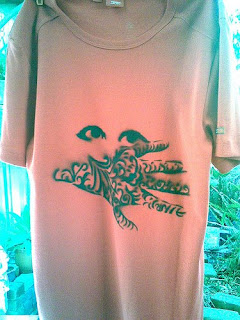
T-shirt Trickery: Create Your Own Recycled T-Shirt or Personalized T Shirt
7:24 PM | T-shirts with 2 comments »Pearls, lustrous concretion produced by certain bivalve mollusks and valued as a gem. Pearls consist almost entirely of nacre, which is the substance forming the inner layers of the mollusk shells. Nacre, known as mother-of-pearl, is composed primarily of aragonite crystals. The pearl is an abnormal growth resulting from the invasion of the body of the mollusk by a minute irritant, such as a parasite. The particle acts as an irritant in the mollusk and becomes coated with layer upon layer of nacreous material. Both marine and freshwater mollusks produce pearls, but the most valuable varieties originate in the pearl oyster of the Persian Gulf.
The most highly prized pearls are spherical. When a pearl that has been cut from the shell presents a hemispherical surface, it is sometimes called a bouton pearl. If a solid pearl has an irregular shape, having grown over a rough object, it is known as a baroque pearl. In the jewelry trade, pearls are commonly known as pear, bell, or drop, according to the shape. Pearl coloration varies widely, the most prized shades being white, black, rose, and cream.
One of the important marine-pearl fisheries on the North American continent is off Baja California, Mexico, the central point being at La Paz. Other fisheries are located in the Gulf of Panama, in the West Indies and the islands of the South Pacific, and along the coasts of India, the Persian Gulf, Japan, Mexico, and western Central America, especially in the Pearl Cays, near the coast of Nicaragua. In Australian waters pearls are fished on the coast of Western Australia and of Queensland and in Torres Strait.
River pearls are produced by freshwater mussels in various parts of the world. China is the principal trader in river pearls.
Natural, spherical pearls have been cultured successfully since 1920. In this process a mother-of-pearl bead, from three-quarters to nine-tenths of the diameter of the desired product, is introduced into the pearl oyster. Over a period of years the oyster deposits layers of nacre around the bead. Cultured pearls are not easily distinguished from genuine pearls except by an expert. The technique of producing spherical cultured pearls was developed in Japan, and the culturing of pearls is a major Japanese industry. Artificial pearls, in contrast to cultured pearls, are entirely artificial, made largely of glass.


 Posts


